How to separate a picking zone from a pallet staging area: The Key to Operational Throughput
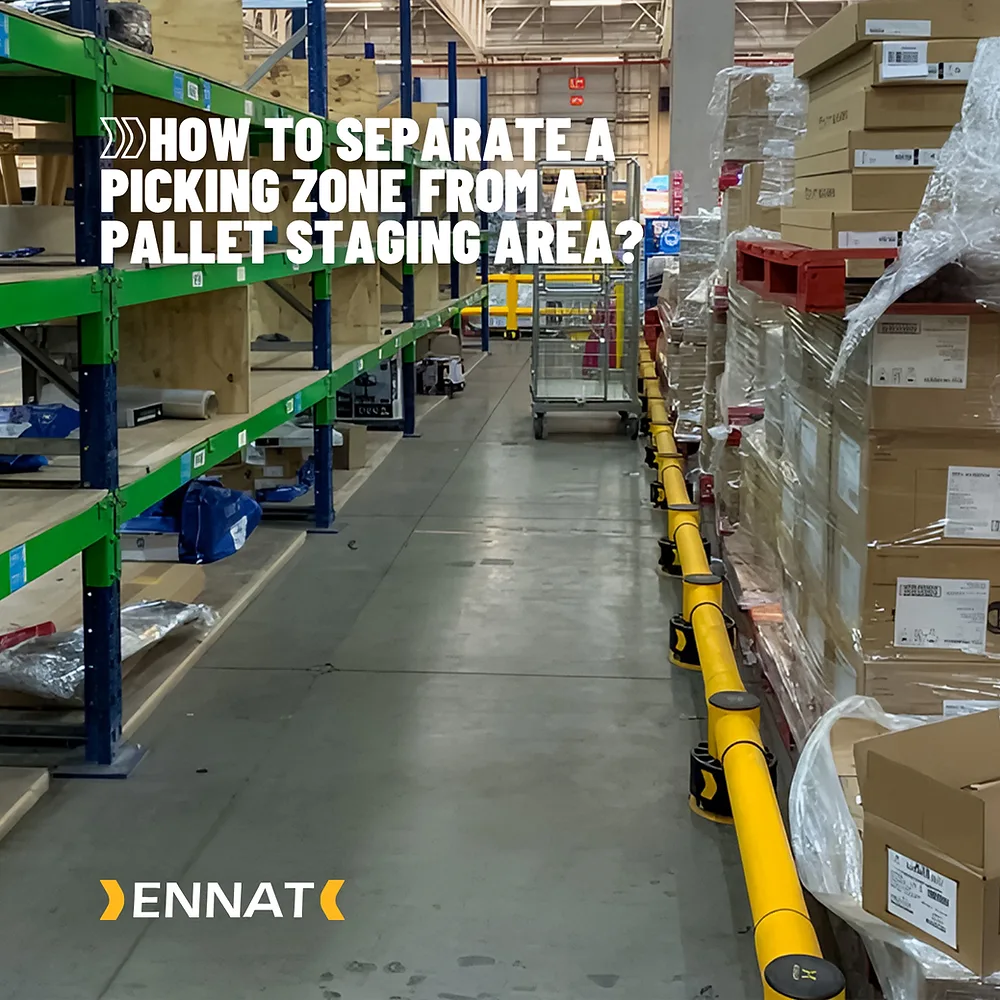
In the fast-paced ecosystem of a modern Distribution Center (DC), the coexistence of different workflows is a constant that defines the success of the supply chain. However, a critical question arises for Operations Managers: how to separate a picking zone from a pallet staging area so that productivity is not hampered by the risk of accidents? In today's high-velocity logistics, the interaction between manual order-picking personnel and heavy machinery is a daily challenge that requires more than just visual cues; it demands a physical segregation infrastructure capable of withstanding the intense industrial dynamics of the US market.
The Challenge: The Risk of Visual-Only Demarcation
For years, many facilities have attempted to solve the dilemma of how to separate a picking zone from a pallet staging area by using only yellow floor tape or painted lines. While floor marking is an OSHA requirement for identifying aisles and work zones (under OSHA 1910.176 and 1910.22), in practice, it is often insufficient. Manual picking operations, which require high personnel concentration to avoid inventory errors, are performed under constant pressure when the workspace is separated only by a line of paint.
This situation creates a significant environment of operational stress. A forklift or electric pallet jack can unintentionally invade the picking space while attempting to stage heavy loads. This encroachment doesn't just lead to operational delays due to constant interruptions; it increases the likelihood of damage to machinery, racking systems, and, in the worst-case scenario, catastrophic personnel injuries. The lack of a real physical barrier turns storage limits into "suggestions" that equipment operators often ignore during peak logistics demand.
The Importance of Physical Segregation in Industrial Layouts
Understanding how to separate a picking zone from a pallet staging area requires a deep dive into industrial layout engineering. It’s not just about safety; it’s about material flow efficiency. Physical segregation allows every actor, the order picker and the forklift driver, to move in their assigned lane with total confidence.
In the US market, adhering to OSHA safety guidelines and ANSI standards is the baseline for protecting asset integrity. When a robust physical edge is established, human error in load positioning is eliminated, ensuring that picking aisles remain clear and functional throughout the entire work shift. This is the difference between a "near-miss" culture and an environment of total operational continuity.
The Technical Solution: ENNAT Low Barrier (Floor Guard)
When searching for how to separate a picking zone from a pallet staging area, the ENNAT Low Barrier emerges as the engineering tool designed specifically for this purpose. This system does not just act as a separator; it serves as a forklift guide that prevents collisions with vulnerable structures and establishes clear, permanent storage boundaries.
Engineering Attributes for Staging Zones:
- Effective Physical Demarcation: Unlike paint or tape, the Low Barrier creates a solid, high-visibility edge. This ensures that pallets stay strictly within their staging zone, preventing "load creep" into the aisles where personnel are performing manual picking.
- Resilience and Active Memory: The most relevant technical component is its ability to absorb impact energy. If a forklift strikes the barrier while positioning a pallet, ENNAT’s hybrid engineering dissipates the force, protecting both the vehicle and the inventory.
- Floor Slab Protection: One of the most frequent problems in US logistics is damage to the concrete floor slab. Traditional rigid steel barriers transfer impact torque directly to the anchor bolts, fracturing the concrete. ENNAT’s base engineering helps prevent this destructive torque from damaging the infrastructure, keeping your facility’s floor intact and extending its lifespan.
Beyond Protection: Profitability and ROI Analysis
We know that investment in safety infrastructure must be data-driven. Therefore, in addition to knowing how to separate a picking zone from a pallet staging area, it is essential to analyze the Return on Investment. On our website, Maintenance and Operations Managers can access our ROI Calculator, a tool designed to project how reducing constant repairs and preserving assets directly impacts your bottom line.
By using high-resilience protection systems, you reduce non-programmed downtime caused by floor repairs or the replacement of damaged metal barriers. This allows picking and staging flows to remain continuous, optimizing the performance of every square foot of your warehouse.
Let Us Design Your Protection Layout at No Cost
The answer to how to separate a picking zone from a pallet staging area varies according to each warehouse's unique needs. A high-rotation retail distribution center faces different challenges than a heavy manufacturing plant. At ENNAT, we offer a technical advisory service where we design your protection layout at no cost, ensuring every barrier is placed at the exact point of highest risk and efficiency.
You Might Also Like to Read:
- OSHA 2026 Standards: The New Rules Every Facility Should Know
- How Data Is Transforming Industrial Safety and Why Physical Protection Still Remains the Key
- Why Forklift Accidents Still Happen and How to Stop Them With High end Forklift Safety Barriers
Specialized Contact:
If you are looking to optimize your workplace and require certified engineering that meets OSHA and FEM standards, contact our specialists:
USA: contact@ennatgroup.com
+1 470 748 6640
Global: www.ennatgroup.com
With ENNAT Solutions, safety and operational efficiency go hand in hand. We don't just protect assets; we guarantee your business's continuity across the region.
Ready to Make Your Facility Safer?¿Listo para Hacer tu Instalación Más Segura?
Book a free consultation with our engineers today.Agenda hoy una consultoría gratuita con nuestros ingenieros.