Industrial Column Protectors: Types, Materials, and Engineering Benefits
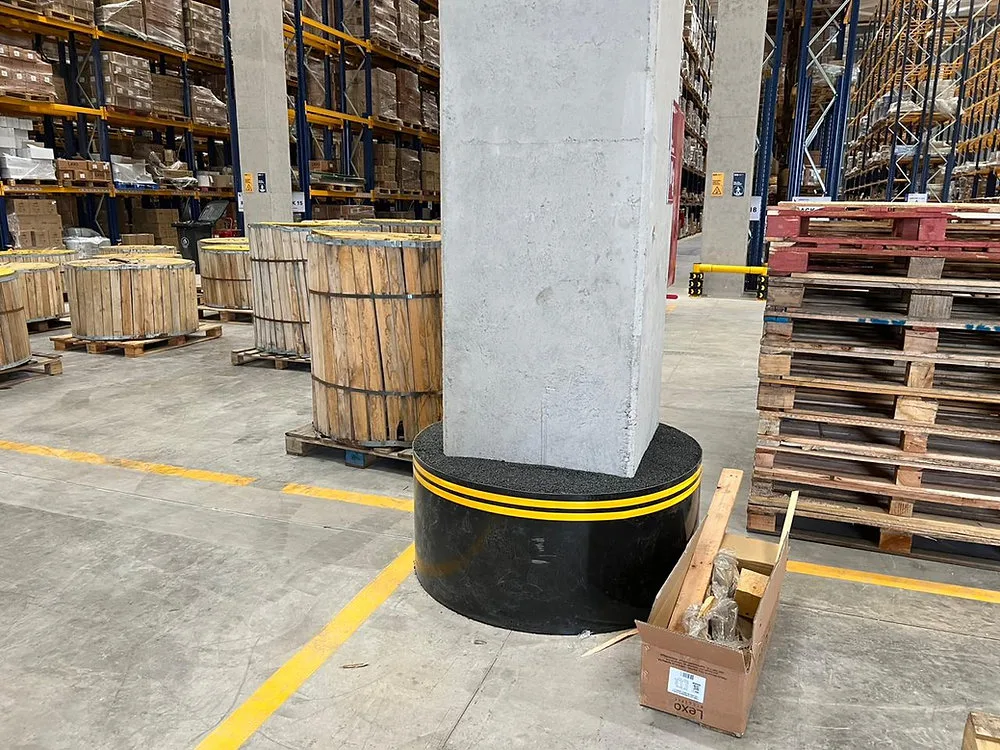
In heavy-duty industrial environments, structural columns are significant liabilities. Whether in a high-velocity distribution center or a manufacturing plant, industrial column protectors serve a critical role: absorbing kinetic energy before it reaches the building's skeleton, thereby preventing structural failure, costly repairs, and safety violations.
At ENNAT, we develop protection systems with Controlled Impact Absorption technology. Our solutions, manufactured from Natural Rubber (NR) and structural steel, are certified under the international FEM 10.2.02 standard.
Why Invest in Industrial Column Protectors?
Every year, facilities lose thousands of dollars in operational hours due to "minor" forklift impacts. While they may appear superficial, these repetitive collisions compromise the integrity of structural pillars and the concrete slab.
The Most Common Risks Include:
- Structural Fatigue: Internal deformations that weaken vertical load support.
- Foundation Damage: Concrete cracks or anchor displacement caused by rigid energy transfer.
- Hidden Maintenance Liabilities: Cumulative costs for unplanned repairs and structural assessments.
- Personnel Risk: Potential for catastrophic failure and immediate production stoppages.
The ENNAT Advantage: Materials & Technology
Our engineering combines materials that maximize energy dissipation and controlled deformation.
- NR Natural Rubber: Features high elasticity and "active memory," allowing the barrier to recover its shape after impact without transferring energy to the anchors.
- ASTM A36 Steel: Provides the necessary rigidity for the modular system, resisting high-energy impacts without fracture.
- Agglomerated Recycled Rubber: A sustainable core option that offers high-rate damping while reducing your facility's environmental footprint.
Key Benefits of ENNAT Industrial Protectors
- FEM 10.2.02 Compliance: International engineering standards for safety.
- Active Memory: Zero permanent deformations after typical impacts.
- Durability: Operating range from 0°F to 160°F.
- Zero Maintenance: No repainting or constant welding required.
- Rapid Installation: Modular systems designed for minimal operational disruption.
Choosing the Right Protection
Your choice of an industrial column protector depends on three technical factors:
- Impact Profile: Frequency and velocity of the materials handling equipment (MHE).
- Environment: Traffic patterns, temperature ranges, and available floor space.
- Regulatory Height: According to FEM 10.2.02, a minimum of 20" (50 cm) for racks and up to 43.3" (110 cm) for structural pillars.
Conclusion
Investing in certified industrial column protectors is not just a safety measure; it is a strategy for operational continuity and infrastructure preservation. ENNAT's modular solutions transform every impact into an opportunity to maintain efficiency and protect your bottom line.
Ready to Make Your Facility Safer?¿Listo para Hacer tu Instalación Más Segura?
Book a free consultation with our engineers today.Agenda hoy una consultoría gratuita con nuestros ingenieros.