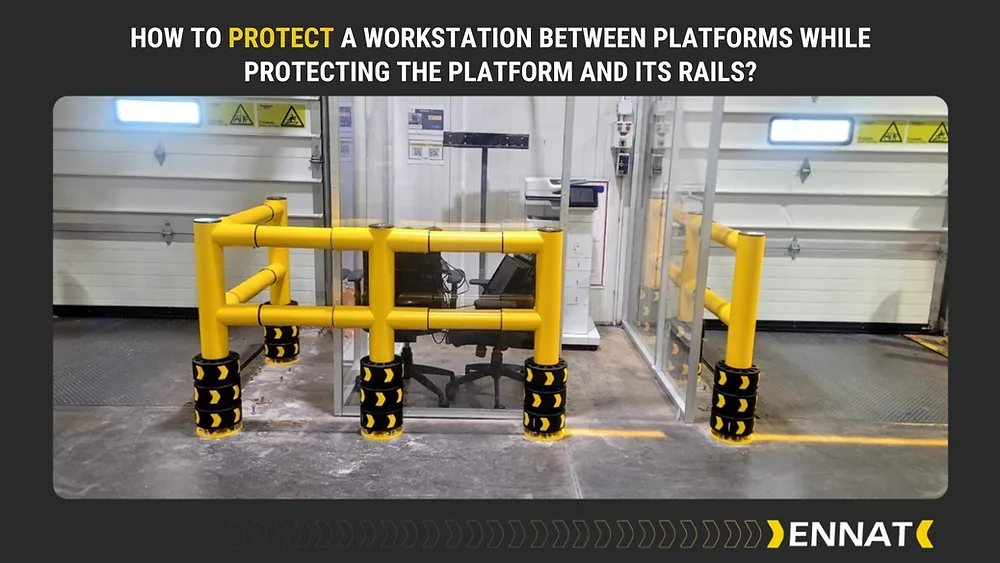
1. THE PROBLEM: An unprotected worker is a potential operational shutdown
In many logistics centers, there are workstations located between docks and loading/unloading areas. While they may seem like standard operational spaces, these zones concentrate some of the highest risks to worker safety:
- Accidents that can halt entire shifts
- Forced reassignment of staff
- Internal investigations, loss of trust, and reputational damage
- Unexpected compensation claims and financial costs
An interruption that costs more than it seems.
Signage alone is not enough. If there is no physical barrier separating workers from hazards, the exposure is direct, and so are the costs. In case of an accident, saying “there was signage” is not a defense. Without real protection, responsibility is unavoidable.
2. WHY YELLOW TAPE ISN’T ENOUGH
In many facilities, lines are painted on the floor or yellow tape is applied as a quick fix. While it may seem sufficient, it creates a false sense of safety.
The most serious risk isn’t a lawsuit… it’s the loss of life.One impact can cause severe or irreversible injuries. Behind every worker is a family, and behind every accident is a story that could have been prevented.
On top of that, from an operational standpoint:
- It won’t stop a forklift moving at full speed
- It won’t protect a worker if a pallet falls
- It won’t prevent a small vehicle deviation from becoming a major impact
A momentary distraction or human error can turn into a tragedy. And when no real barrier exists to separate people from risk, no legal or operational argument can justify it.
3. THE ENNAT SOLUTION: Active Protection by Design
With over 12 years of experience in logistics and industrial safety, ENNAT has developed real containment systems, engineered for today’s operational needs and centered on human protection.
Recommended Solutions:
- Double Guardrail System (Barrera Doble):Modular, dual-level protection with an impact-absorbing base. Designed to stop vehicles without damaging floors or nearby workers. Controlled deformation reduces impact energy before it reaches critical zones.
- Rotational Energy-Absorbing Bollards:Strategically installed between docks and loading zones, these bollards redirect vehicles without blocking access. Engineered to protect both workers and structural elements such as rails.
- Pedestrian Guardrails:Create physical perimeters separating people and machinery. These modular barriers allow quick reconfiguration if workflows change, without disrupting operations.
4. REAL CASES IN LATAM
Logistics and food industry companies in Mexico and Chile have reduced dock-related incidents by up to 80% by implementing ENNAT protection systems.
They also reported:
- Fewer damages to metal structures
- Higher operational continuity
- Stronger perception of safety among staff
A key finding: when people are protected first, infrastructure, products, and equipment also benefit.
5. WHAT ENNAT RECOMMENDS BEFORE IMPLEMENTATION
Every protection project should begin with a technical evaluation. ENNAT suggests analyzing:
- Type of vehicles in circulation (forklifts, pallet jacks, trucks)
- Distance between docks and workstation characteristics
- Daily level of human interaction in the area
- High-impact or collision-prone zones
With this data, ENNAT can deliver a tailored solution and provide a FREE demo unit for testing in critical zones.
🔒 Safety first. Everything else comes after.
Protecting your workers and assets means protecting your operation. Don’t wait for an accident to act.
📩 Request a demo today:👉 contact@ennatgroup.com🌐 www.ennatgroup.com
Ready to Make Your Facility Safer?¿Listo para Hacer tu Instalación Más Segura?
Book a free consultation with our engineers today.Agenda hoy una consultoría gratuita con nuestros ingenieros.